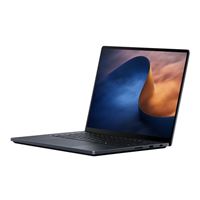
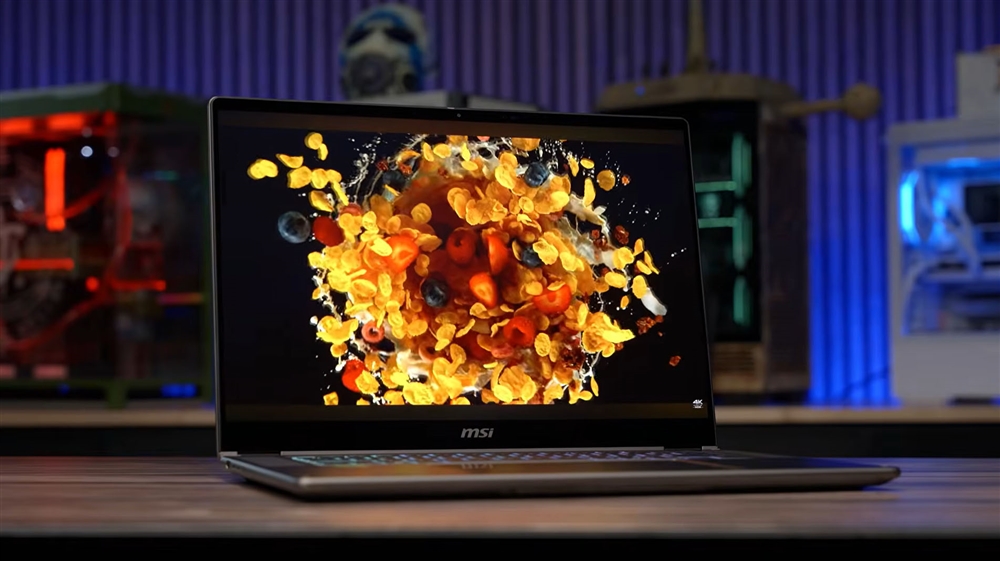
The first RTX Spark laptops are here, and with them, our first round of benchmarks for this new breed of laptop.
First announced at Computex, RTX Spark is NVIDIA's first complete laptop processor, with CPU, GPU, and memory on a single package. The first laptops launch October 16, and include the machine tested here, the Surface Laptop Ultra from Microsoft.
At the heart of RTX Spark is a bespoke System-on-Chip (SoC) co-developed with MediaTek. The flagship configuration, named the N1X, combines a 20-core NVIDIA Grace CPU (featuring a cluster of high-performance Arm Cortex-X925 and power-efficient A725 cores) with a Blackwell-generation RTX GPU packing 48 Streaming Multiprocessors and up to 6,144 CUDA cores. If that core count sounds familiar to PC builders, it should: it sits right in line with NVIDIA's desktop GeForce RTX 5070 class.
By supplying up to 128GB of shared LPDDR5X unified memory, the Grace CPU and Blackwell GPU share direct access to the same memory space. Armed with NVIDIA's 5th-generation Tensor Cores and native FP4 micro-scaling, an RTX Spark laptop can load and run massive 120-billion-parameter LLMs locally.
We ran our new Micro Center AI benchmarks on the Surface Laptop Ultra, and the initial results are below.
Unless noted, higher is better. A short prompt is about 90 tokens and a long prompt is about 9,000. The RTX Spark laptop ran NVIDIA's native ARM64 build of llama.cpp.
Generation speed
Output tokens per second once the model starts answering.
Generation speed (output tokens per second)
Model / prompt
RTX Spark (Surface Laptop Ultra)
GLM 4.7 Flash
General, short prompt
55.6
General, long prompt
48.9
Coding, short prompt
55.4
Coding, long prompt
49.0
Nemotron 3 Nano Omni 30B
General, short prompt
63.9
General, long prompt
62.6
Coding, short prompt
64.0
Coding, long prompt
63.0
Qwen3.5 122B A10B
General, short prompt
35.2
General, long prompt
34.0
Coding, short prompt
35.3
Coding, long prompt
35.0
Muse Glimmer 30B
General, short prompt
15.9
General, long prompt
15.6
Coding, short prompt
15.9
Coding, long prompt
15.6
Qwen3.8 27B
General, short prompt
14.5
General, long prompt
14.1
Coding, short prompt
14.8
Coding, long prompt
14.3
Prompt processing speed
How quickly each system reads your prompt, in prompt tokens per second.
Prompt processing speed (prompt tokens per second)
Model / prompt
RTX Spark (Surface Laptop Ultra)
GLM 4.7 Flash
General, short prompt
452
General, long prompt
1,336
Coding, short prompt
457
Coding, long prompt
1,341
Nemotron 3 Nano Omni 30B
General, short prompt
352
General, long prompt
1,865
Coding, short prompt
360
Coding, long prompt
1,835
Qwen3.5 122B A10B
General, short prompt
168
General, long prompt
604
Coding, short prompt
183
Coding, long prompt
611
Muse Glimmer 30B
General, short prompt
253
General, long prompt
782
Coding, short prompt
263
Coding, long prompt
786
Qwen3.8 27B
General, short prompt
352
General, long prompt
665
Coding, short prompt
338
Coding, long prompt
669
Time to first token
How long you wait before the first word of the answer appears, in seconds. Lower is better.
Time to first token (seconds, lower is better)
Model / prompt
RTX Spark (Surface Laptop Ultra)
GLM 4.7 Flash
General, short prompt
0.19
General, long prompt
6.79
Coding, short prompt
0.20
Coding, long prompt
6.43
Nemotron 3 Nano Omni 30B
General, short prompt
0.29
General, long prompt
5.36
Coding, short prompt
0.30
Coding, long prompt
5.09
Qwen3.5 122B A10B
General, short prompt
0.58
General, long prompt
16.38
Coding, short prompt
0.55
Coding, long prompt
15.48
Muse Glimmer 30B
General, short prompt
0.55
General, long prompt
11.45
Coding, short prompt
0.54
Coding, long prompt
11.03
Qwen3.8 27B
General, short prompt
0.40
General, long prompt
14.92
Coding, short prompt
0.43
Coding, long prompt
14.20
Efficiency and power
Output tokens per watt-hour of energy (higher is better) and average GPU power draw while generating, in watts (lower is better), across 40 requests per model (4 prompts x 10 runs).
Efficiency and GPU power while generating, RTX Spark (Surface Laptop Ultra)
Model
Tokens per watt-hour
Avg. power (W, lower is better)
GLM 4.7 Flash
2,992
47
Nemotron 3 Nano Omni 30B
3,894
44
Qwen3.5 122B A10B
1,665
48
Muse Glimmer 30B
1,117
43
Qwen3.8 27B
1,010
43
Gaming: Cyberpunk 2077
We also ran Cyberpunk 2077's built-in benchmark on the Surface Laptop Ultra at 1080p, 1440p, and its full 3270 x 2180 resolution. Native means DLSS and frame generation are off. DLSS Balanced uses the Transformer model with frame generation off, and DLSS + 4x FG adds multi-frame generation. RT Low turns on local shadow ray tracing only; RT Ultra adds reflections, sun and local shadows, and Ultra lighting. Path tracing is off.
Cyberpunk 2077 average frames per second
Setting / mode
1080p
1440p
Full res (3270 x 2180)
Low / Native
91.32
81.60
53.90
Low / DLSS Balanced
95.75
90.89
69.69
Low / DLSS + 4x FG
305.65
196.60
145.52
Ultra / Native
71.90
48.58
25.43
Ultra / DLSS Balanced
82.14
65.34
39.53
Ultra / DLSS + 4x FG
224.10
151.20
105.40
RT Low / Native
68.44
44.21
23.76
RT Low / DLSS Balanced
82.96
61.58
37.42
RT Low / DLSS + 4x FG
215.95
147.26
100.62
RT Ultra / Native
32.27
21.48
13.61
RT Ultra / DLSS Balanced
52.44
37.60
24.45
RT Ultra / DLSS + 4x FG
155.86
109.96
76.47
Frame-generation results include generated frames. Each result is a single pass of the roughly 64-second built-in benchmark, tested on October 11, 2026, with game version 2.31 and driver 617.42.
RTX Spark laptops are coming to Micro Center, with systems hitting shelves starting October 16. Brands to look for include Asus, Dell, HP, Lenovo, Microsoft, and MSI. Stay tuned and we'll bring you more benchmark testing and hands-on reviews, plus all the RTX Spark shopping advice you'll need, and if you want to see these machines in person, keep an eye on your local Micro Center.
Micro Center Editor-in-Chief Dan Ackerman is a veteran technology journalist with over 20 years of experience testing and reviewing the latest consumer tech. He previously served as Editor-in-Chief of Gizmodo and Editorial Director at CNET and is the author of the New York Times-reviewed book The Tetris Effect, a critically acclaimed Cold War history of the world's most influential video game. Reach him at dackerman at microcenter.com.