
Watch NVIDIA AI Experts go Hands-on with DGX Spark
A series of hands-on interviews conducted at Micro Center Santa Clara help us tame the wild west of AI.How-To

Artificial intelligence has become a powerful force in the past few years, but for many developers, researchers, and enthusiasts, harnessing that power has meant relying on costly cloud instances or waiting in line for data center resources. NVIDIA is at the forefront of an effort put an AI supercomputer on the desk of every developer with the launch of the new DGX Spark.
Just a week after the launch, Micro Center's Jordan Carrasquillo sat down with a group of AI experts from NVIDIA at our new Santa Clara store to get a hands-on walkthrough with the new machine. The main takeaway was that the DGX Spark is a milestone for local AI, designed to solve the two biggest problems developers face today: memory constraints and software complexity.
You can see the entire series of interviews and demo sessions in the video above.
"We were talking to a number of developers, and we were soon realizing each of these developers were using some kind of a local system... either a laptop, a PC, [or] a workstation," explained Sama Bali, Senior Product Marketing Manager for AI and Data Science Solutions at NVIDIA. "But there were two key issues we kept hearing again and again. One, they didn't have enough memory on their system to manage all these gigantic models. Second, they did not have access to the right software stack for AI workflows."
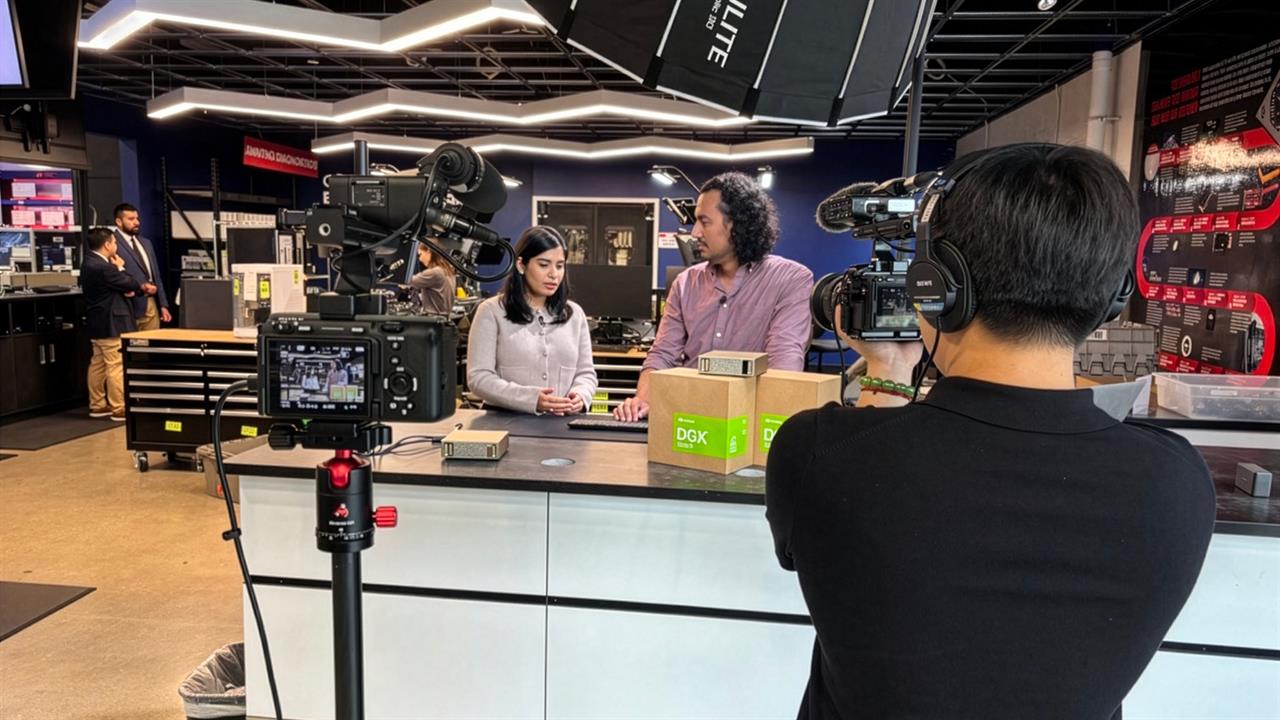
Image: Micro Center
The DGX Spark is NVIDIA's answer. It's small enough to fit in the palm of your hand, yet it packs the new GB10 Grace Blackwell superchip and a massive 128GB of LPDDR5X unified memory. This allows it to deliver up to a petaflop of AI compute, giving developers the power to finally run and fine-tune massive models right on their desks.
As Bali explained, this isn't just about inference. "The idea behind this was to help you develop AI and AI systems," she said. It's a "great device for anybody who's looking to prototype with different kinds of models [or] who is looking to fine-tune different kinds of LLMs and VLMs and more."
Local fine-tuning
To prove the point, NVIDIA systems software engineer Lakshmi Ramesh walked us through a powerful demo: locally fine-tuning a diffusion model.
Starting with Flux, a well-known open-source diffusion model, Ramesh described how she's using it to generate a "Toy Jensen" image -- a popular test case for AI image generation based on NVIDIA CEO Jensen Huang.
"The base Flux model that is out there cannot do concepts that are very particular to your use case, for example, custom concept generation," she said. "What we are trying to do is to ask this open source model to generate Toy Jensen and see how that goes." The initial result, after 50 steps, was a generic-looking toy that bore little resemblance to the real thing.
This is where the power of local fine-tuning comes in. Ramesh explained: "What we are going to do is we are going to take like five to 10 images of Toy Jensen on the internet, and we are going to take five to 10 images of Spark, also available on the internet, and we are going to do DreamBooth LoRA fine-tuning locally on DGX Spark."
Fine-tuning is essentially taking a base model and training with a custom data set, usually smaller and more specific, so it can perform better on specialized tasks.
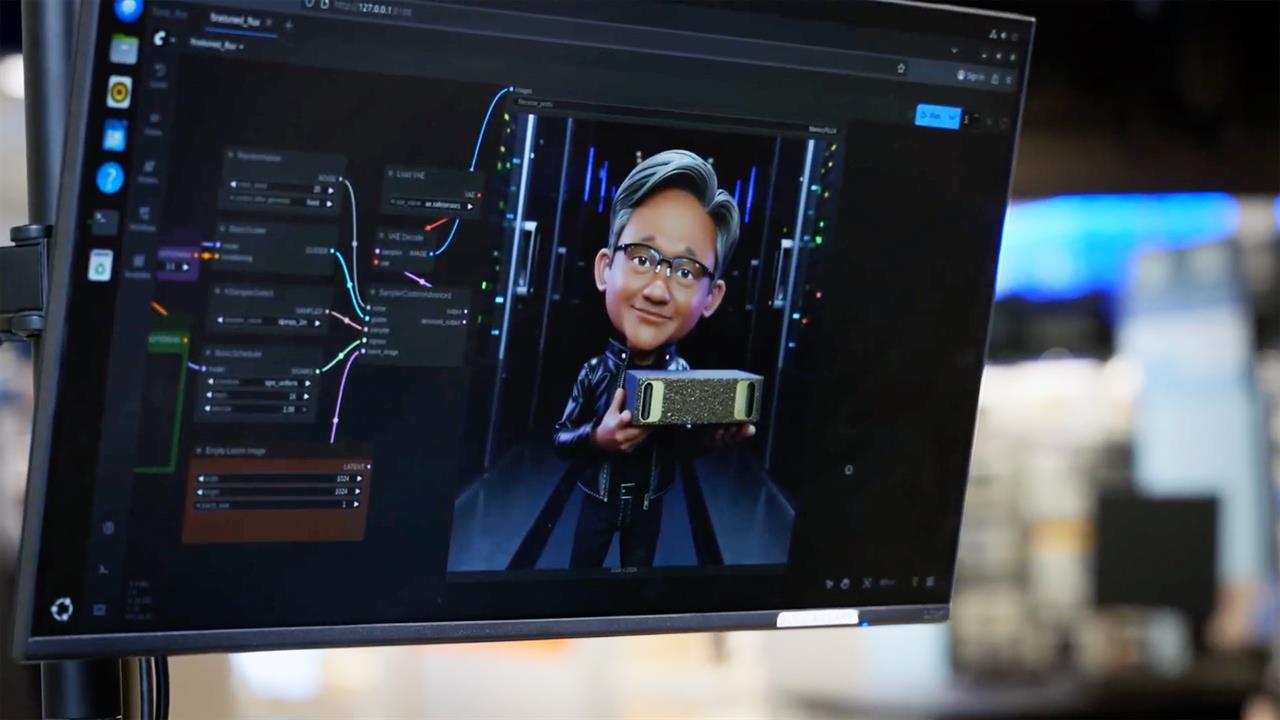
Image: Micro Center
After being fine-tuned on that tiny, custom dataset, the model was transformed. The new "Toy Jensen" image looked great and was generated in only 16 steps -- a significant speed-up from the base model's 50. That's one of the big pitches behind the DGX Spark -- allowing developers to take open-source models and safely, quickly, and privately adapt them with new custom data.
AI video analysis and multi-agent chatbots
Micah Guimarin, a technical marketing engineer at NVIDIA, demoed video search and analysis. Using NVIDIA's Cosmos Reason VLM (Vision Language Model), the DGX Spark processed a demo video clip and allowed the user to interact with it using natural language.
Guimarin ran the video of a person crossing the street and asked the AI, "Is the person walking on the white striped crosswalk?" The system processed the minute-and-a-half clip in just 63 seconds. He could then use a chat interface to ask further questions. "How long did it take for the person to walk across?" The AI responded: "It took the person 12 seconds."
This local-first approach to video analysis opens up powerful use cases for anyone with large video archives who needs to analyze footage without uploading sensitive data to the cloud.
Finally, NVIDIA Senior Software Engineer Chantal D Gama Rose demonstrated the most complex workload of the day: a multi-agent chatbot system running entirely on the DGX Spark. This wasn't just one model, but four, all loaded into the 128GB of unified memory simultaneously.
"We have GPT-OSS 120B that's acting as the supervisor model," she explained. "We have an embedding model and we have an image understanding model, using Qwen 2.5 VL, we have a coding model, DeepSeek Coder 6.7B."
Using this multi-agent configuration took up the large VRAM pool and acted as an advanced assistant. When asked a simple question, the supervisor model answered directly. But when asked a question about an uploaded document (in this case, a white paper on Blackwell GPUs), the supervisor "realized that it doesn't have all the context" and automatically routed the query to the RAG (Retrieval-Augmented Generation) agent, which could retrieve the specific information from the document and provide a cited answer.
Who is the DGX Spark For?
Throughout the demos, the NVIDIA team was clear about the DGX Spark's intended audience. This isn't a replacement for a gaming PC. It's a purpose-built tool for AI developers, "prosumers" (professionals who are also consumers), students, and startups.
It's designed to democratize AI development. "We wanted to make sure we're democratizing the use of AI," said Bali. "We don't want to stop that creativity."
For a startup, the $4,000 price is a cost-effective alternative to enterprise-level cloud services. For a researcher in a regulated industry like finance or healthcare, it's a secure way to experiment with proprietary data. And for the enthusiast or entrepreneur, it's a launchpad to go from just using AI to actually building it. The NVIDIA DGX Spark is available now at Micro Center.
More from MC News
- Hands-on with the NVIDIA DGX Spark
- How to Build a PC with a Hardline Water-Cooling Loop
- 3D Print a Mac Mini Monitor Mount
- The End Has Come for Windows 10: Four Tips to Make the Most of Windows 11
- Everything You Need to Know About WiFi 7
- Keyboard 101: Intro to Computer Keyboards
- Can Your PC Run OpenAI's New GPT-OSS Large Language Models?
- Fix It Yourself: Talking to iFixit on Why Repairable Tech Matters
Dan Ackerman is the Editor-in-Chief of Micro Center News. A veteran technology journalist with nearly 20 years of hands-on experience testing and reviewing the latest consumer tech, he previously served as Editor-in-Chief of Gizmodo and Editorial Director at CNET. He is also the author of The Tetris Effect, the critically acclaimed Cold War history of the world's most influential video game. Contact Dan at dackerman at microcenter.com.