
Acer at CES 2026: New High-Speed Displays and New AI Flagships


Photo: Dan Ackerman
At CES 2026, Acer announced a huge number of new devices. We've combed through it all to pull out the products we're most excited about and gaming hardware and AI laptops are at the top of that list. Here’s what’s caught our eye:
Acer's new gaming monitors and updated laptops
The most technologically impressive product Acer showed is the Predator XB273U F6, a 27-inch monitor designed for users who prioritize motion clarity above all else. At its native 2,560x1,440 resolution, it runs at a super-high 500Hz refresh rate.
But it gets better: Acer also offers a dynamic frequency and resolution mode that drops the resolution to 1280×720, but increases the refresh rate up to 1,000Hz. It also has a QHD IPS panel, broad color coverage, and an adjustable stand.For those who obsess over frame pacing, latency and framerates, definitely keep an eye on this one. For everyone else, it’s likely overkill. Expect it in Q2 at an MSRP of $799.99.
The Acer Nitro XV270X P takes a more balanced approach to the Predator, combining a very high resolution with a high-refresh fallback mode, rather than committing entirely to one or the other as the Predator does. The Nitro runs at a high 5K (5,120x2,880) resolution and a typical 72Hz refresh rate, more than reasonable for any work or content you might be creating; however, it can switch to a 1,440p resolution at a 144Hz refresh rate. Expect it in Q2 at an MSRP of $799.99.
Acer is also updating its higher-end gaming laptop line with the Predator Helios Neo 16S AI, which uses a slim 18.99mm thick metal chassis, a 16-inch OLED display, along with a current-gen Intel Core Ultra processor and NVIDIA’s RTX 50-series laptop GPUs.
Spec-wise, the Helios Neo 16S AI supports up to 64 GB of DDR5 memory and up to 2TB of PCIe Gen 4 storage, with a cooling setup that includes liquid metal and Acer’s latest AeroBlade fan design. Connectivity is what you’d expect from a performance system, including Thunderbolt 4 and Wi-Fi 6E. This is a conventional high-end gaming laptop updated with 2026 hardware. Nothing innovative here, just evolutionary improvements. Expect this laptop in June or July 2026, with no MSRP announced yet.
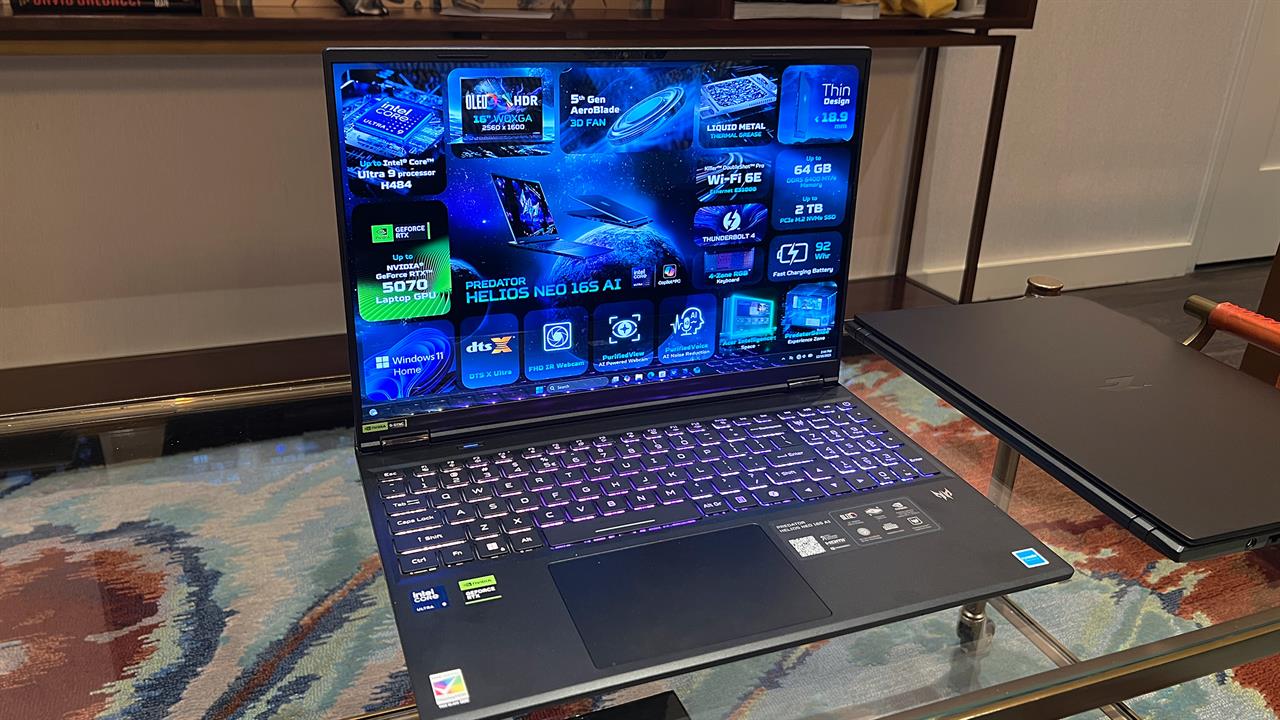
Photo: Dan Ackerman
Acer's new AI laptops
The most interesting new AI-capable laptop in the lineup might be the Acer Swift 16 AI. The standout feature here is the oversized haptic touchpad, which at 175.5mm x 109.7mm is the largest haptic touchpad ever, according to Acer. It also supports stylus input.
Beyond that, the Swift 16 AI checks the boxes you’d expect from a premium thin-and-light: 16-inch 3K OLED WQXGA+ display, Intel Core Ultra 7 processor, and a slim aluminum build. This makes sense for buyers who want a large, high-quality screen in a still technologically portable package, but it won't be the smallest laptop you've ever toted around.
If portability matters more than screen size, however, the Swift Edge 14 AI might be more up your alley. At under 2.2 pounds, the Swift Edge 14 AI combines an OLED display and Intel Core Ultra processors in a metal chassis, weighing less than most Windows laptops.
For more mainstream fare, the Swift Go AI and Aspire AI models have both been updated with newer processors and AI features, with little else changing in their design.
The outlook for 2026
Acer’s CES 2026 announcements come down to a few clear choices. On the gaming side, its hardware is built for very specific use cases, pushing refresh rates and display modes well past what most will ever use. On the laptop side, we see lighter designs, OLED screens showing up more often, and newer processors folded into older form factors.
Read more: Stay up to date with everything we've seen at CES 2026
More from MC News
- Run AI Locally: The Best LLMs for 8GB, 16GB, 32GB Memory and Beyond
- Quantization Explained: Why the Same LLM Gives Better Results on High-End Hardware
- Why VRAM and Memory Bandwidth are Key for Powering Local AI
- Hands-on with NVIDIA DGX Spark: Everything You Need to Know
Eric Franklin worked at CNET for over two decades, eventually becoming Editorial Director of CNET's Tech Reviews team. He now works as an SEO consultant and freelance writer.