
How Much Trust Do We Put in AI?
This report explores how Americans use and trust artificial intelligence in everyday life, based on a survey of 1,000 people examining attitudes toward AI tools, verification habits, and the ability to recognize AI-generated content. The findings reveal a growing reliance on AI for work, information, and decision-making.News

In just a few years, AI has gone from a theoretical future to a near-constant companion. At Micro Center, we live at the center of what’s now and what’s next, and that means not only providing the hardware that makes this technology possible, but also understanding how to use these tools responsibly.
It's one thing to discuss the computer specs required to run a Large Language Model; it's another to see how AI is actually moving into our homes and offices. To better understand the human side of this shift, we surveyed people about their experiences and expectations around artificial intelligence.
The results reveal a fascinating mix of attitudes and opinions. More than half of us use AI to polish our work and trust it to write emails or texts. Nearly 4 in 10 use AI for medical advice, even if we are not as certain that we trust it for health-related queries.
The prevailing attitude toward AI right now is best described as “trust but verify.” In our survey, 57% of people felt confident they could spot an AI-generated image, which was remarkably close to the 55% who actually got it right when put to the test.
Whether you want to vibe code an app, use AI to analyze business data, or just figure out if an online photo is real, this survey is a wake-up call to remain on top of the latest AI developments. It's an incredible co-pilot, but we still need to keep our (human) hands on the controls.
Explore all of our findings below for a deeper look at how we're navigating this new reality.
Dan Ackerman
Editor in Chief, Micro Center
How Much Trust Do We Put in AI?
Artificial intelligence is now part of how many people write, learn, research, and solve problems. To understand how that shift is playing out, we surveyed 1,000 Americans about how they use AI, how much they trust it, and how often they verify what it gives them. We also looked at confidence in identifying AI-generated content and whether trust and recognition differ by generation.
What emerged is not a simple story of blind trust or deep skepticism. Americans are relying on AI more often, sometimes as a first stop, while also expressing concern about accuracy, misinformation, and their own ability to tell what is real.
Key Findings
- Google’s AI mode is the most trusted AI tool, with 86 percent of users saying they trust its responses.
- Only 30 percent of respondents say they trust AI for medical advice, yet 39 percent report using it for medical guidance.
- Americans report trusting AI over friends, family, and even therapists when it comes to problem-solving.
- 57 percent of respondents say they are confident they can identify AI-generated images, but only 55 percent correctly identified which image was AI-generated when tested.
- Twenty-seven percent of Americans say they are fooled by AI-generated content on social media at least once a day.
In AI We Trust?
Not all AI tools inspire the same level of confidence. When people decide whether to trust an AI response, familiarity and perceived reliability appear to matter as much as accuracy.
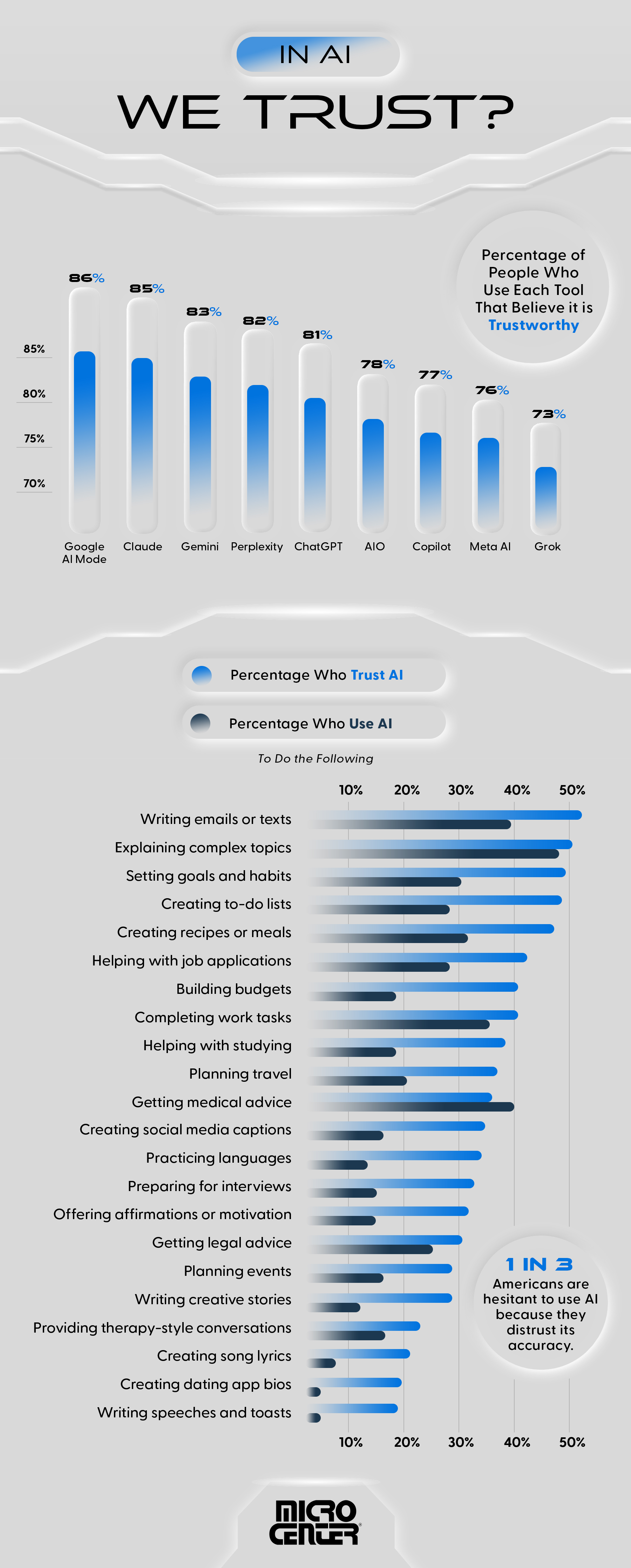
Google’s AI mode stands out, with 86 percent of users saying they trust its
responses. Even the least trusted tool in the survey, Grok, is still trusted by
nearly three-quarters of its users. This suggests skepticism exists, but it rarely
leads to outright avoidance.
Trust also shifts depending on what people are asking AI to do. Writing messages, explaining topics, and helping set goals or habits are among the tasks people trust AI with most. Medical advice is where the tension becomes clearer.
What makes one AI feel trustworthy enough to rely on, even when doubts remain? Usefulness and convenience often outweigh hesitation. Trust here appears to be situational.
AI as a Trusted Partner
For many Americans, AI is no longer just a background tool. It has become an active part of how they work, communicate, and think through problems.
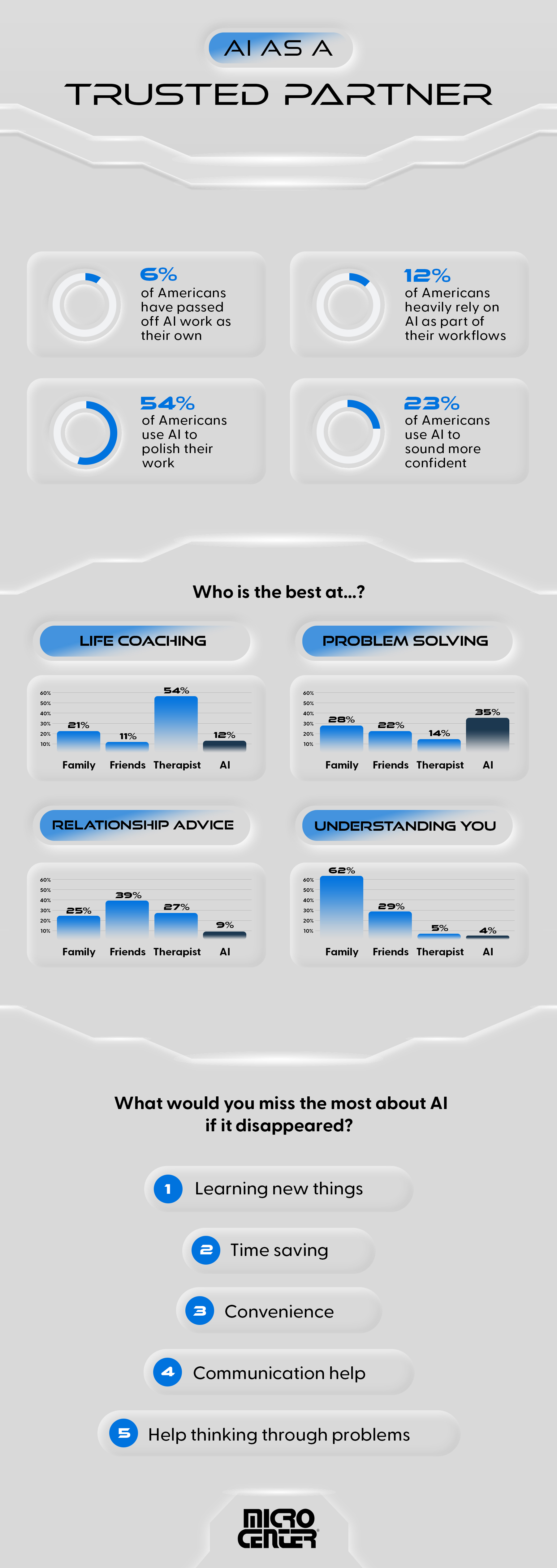
More than half of respondents say they use AI to polish their work, and nearly one
in four use it to sound more confident. About one in ten Americans relies heavily
on AI as part of their regular workflows.
What stands out is how people compare AI to the humans in their lives. When asked who is best at problem-solving, many respondents ranked AI above friends, family, and even therapists.
Trust, But Verify
Relying on AI does not always mean taking its answers at face value, but verification habits vary widely.
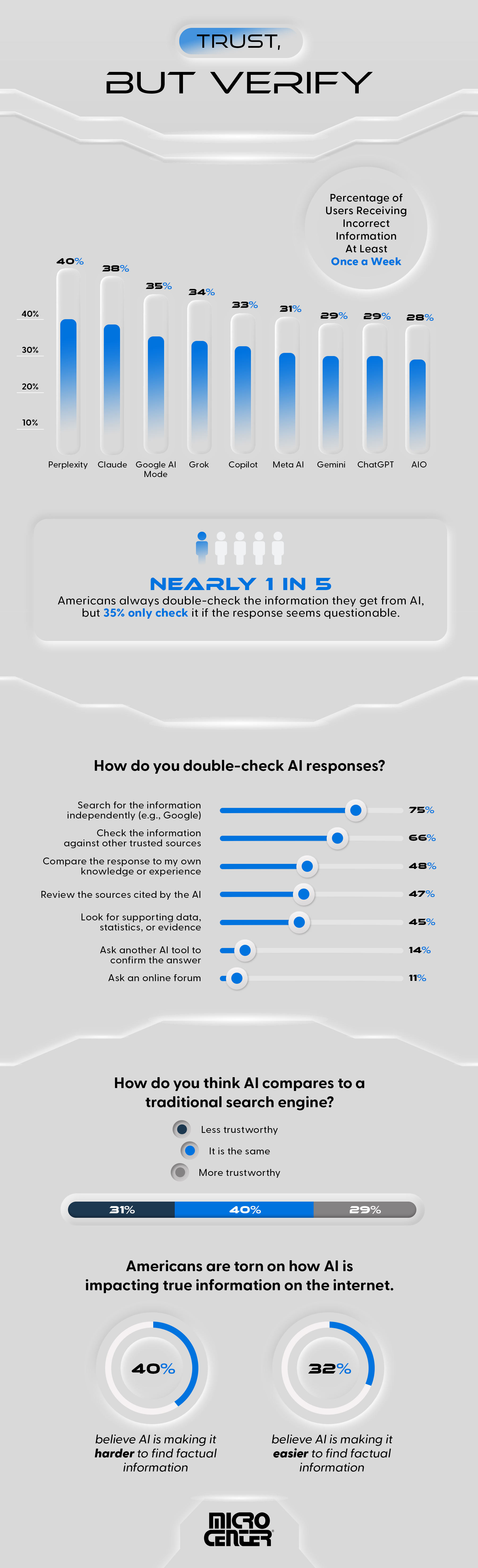
Nearly one in five Americans says they always double-check the information they
get from AI. On the other end, 35 percent say they only verify answers if something
seems questionable.
Rather than consistent skepticism, the data points to selective verification. Many people appear to trust AI by default and step in only when something triggers doubt.
Seeing Doesn’t Mean Believing
AI-generated images are now a regular part of many people’s social feeds. Two in three Americans say they see AI-generated content at least once a day, and one in three encounter it multiple times daily.
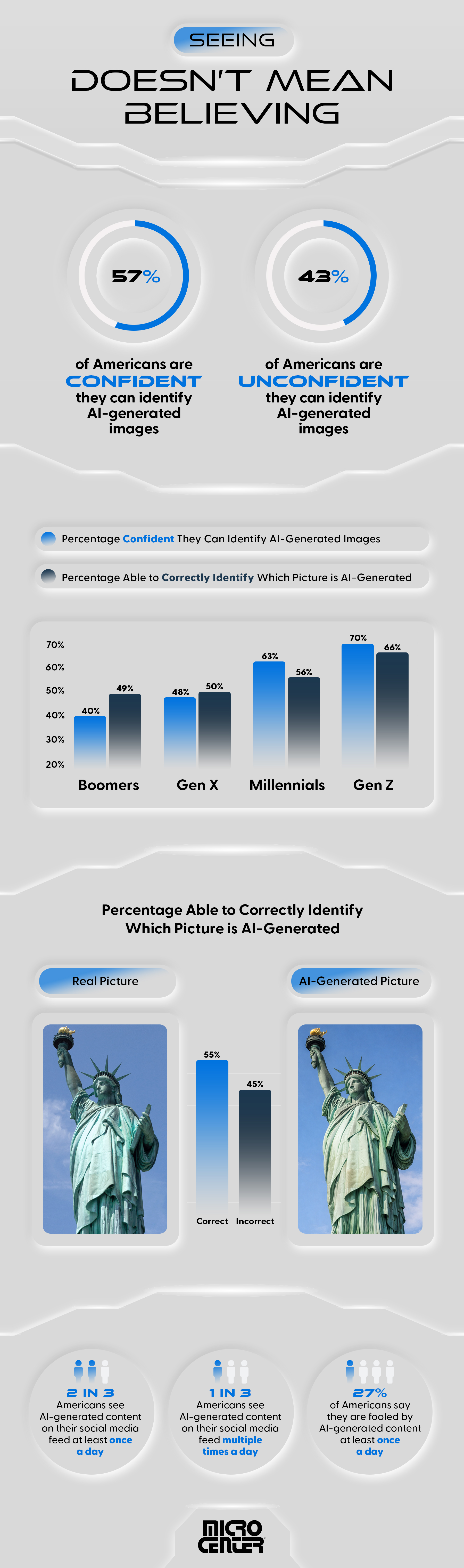
Frequent exposure, however, does not guarantee easy recognition. Fifty-seven
percent of respondents say they are confident they can identify AI-generated
images. When tested, 55 percent correctly identified which image was created by AI.
Generational differences add another layer. When it comes to identifying AI-generated images, Gen X and Boomers outperformed their own confidence levels, while younger generations showed significant overconfidence despite higher overall accuracy scores.
Closing Takeaway
Taken together, the data show a relationship with AI shaped by trust, convenience, and confidence that is not always earned. Many Americans rely on AI daily without consistently verifying what it provides or accurately recognizing when content is AI-generated.
As AI continues to blend into everyday life, the question is not whether people trust it, but how that trust is formed, tested, and sometimes misplaced.
Methodology
We surveyed 1,000 Americans about how they use artificial intelligence and how they experience AI-generated information. Respondents included 10 percent baby boomers, 29 percent Gen X, 47 percent millennials, and 14 percent Gen Z. All findings reflect self-reported behaviors and perceptions at the time of the survey.
Micro Center AI Survey Results
1. AI as a Trusted Partner |
Key Statistics
| Metric | Percentage |
|---|---|
| Have passed off AI work as their own | 6% |
| Heavily rely on AI as part of their workflows | 12% |
| Use AI to polish their work | 54% |
| Use AI to sound more confident | 23% |
Who is the best at...?
| Category | Family | Friends | Therapist | AI |
|---|---|---|---|---|
| Life Coaching | 21% | 11% | 54% | 12% |
| Problem Solving | 28% | 22% | 14% | 35% |
| Relationship Advice | 25% | 39% | 27% | 9% |
| Understanding You | 62% | 29% | 5% | 4% |
What would you miss most about AI if it disappeared? (Ranked)
| Rank | Benefit |
|---|---|
| 1 | Learning new things |
| 2 | Time saving |
| 3 | Convenience |
| 4 | Communication help |
| 5 | Help thinking through problems |
2. In AI We Trust? |
Percentage of Users Who Believe Tool is Trustworthy
| Tool | Trustworthy % |
|---|---|
| Google AI Mode | 86% |
| Claude | 85% |
| Gemini | 83% |
| Perplexity | 82% |
| ChatGPT | 81% |
| AIO | 78% |
| Copilot | 77% |
| Meta AI | 76% |
| Grok | 73% |
AI Tasks: Use vs. Trust
| Task | Use AI % | Trust AI % |
|---|---|---|
| Writing emails or texts | 39.18% | 50.45% |
| Explaining complex topics | 48.55% | 50.15% |
| Setting goals and habits | 30.01% | 48.55% |
| Creating to-do lists | 27.52% | 48.15% |
| Creating recipes or meals | 30.81% | 47.05% |
| Job applications (resumes, cover letters) | 27.62% | 42.14% |
| Building budgets | 18.05% | 40.14% |
| Completing work tasks (reports, etc.) | 34.60% | 39.64% |
| Helping with studying | 18.25% | 37.34% |
| Planning travel | 19.54% | 36.54% |
| Getting medical advice | 39.28% | 36.14% |
| Social media captions | 15.75% | 35.04% |
| Practicing languages | 13.36% | 34.13% |
| Preparing for interviews | 14.86% | 33.13% |
| Affirmations or motivation | 14.66% | 31.83% |
| Legal or financial advice | 24.63% | 30.23% |
| Planning events | 15.55% | 27.53% |
| Writing creative stories | 11.96% | 27.53% |
| Therapy-style conversations | 15.95% | 22.92% |
| Creating song lyrics | 5.88% | 21.22% |
| Dating app bios | 3.39% | 18.92% |
| Writing speeches and toasts | 3.29% | 18.32% |
Note: 1 in 3 Americans are hesitant to use AI because they distrust its accuracy.
3. Seeing Doesn’t Mean Believing |
Confidence in Identifying AI Images
| Confident | 57% |
| Not Confident | 43% |
Generation Gap: Confidence vs. Actual Accuracy
| Generation | Confidence % | Actual Accuracy % |
|---|---|---|
| Boomers | 40% | 49% |
| Gen X | 48% | 50% |
| Millennials | 63% | 56% |
| Gen Z | 70% | 66% |
Statue of Liberty Test: Correct Identification
| Correct | 55% |
| Incorrect | 45% |
4. Trust, But Verify |
Receiving Incorrect Info (At Least Weekly)
| Tool | Frequency % |
|---|---|
| Perplexity | 40% |
| Claude | 38% |
| Google AI Mode | 35% |
| Grok | 34% |
| Copilot | 33% |
| Meta AI | 31% |
| Gemini | 29% |
| ChatGPT | 29% |
| AIO | 28% |
How Do You Double-Check AI Responses?
| Method | Percentage |
|---|---|
| Search independently (Google) | 75% |
| Check against other trusted sources | 66% |
| Compare to own knowledge/experience | 48% |
| Review sources cited by AI | 47% |
| Look for supporting data/statistics | 45% |
| Ask another AI tool | 14% |
| Ask an online forum | 11% |
AI Trust vs. Traditional Search Engines
| Less trustworthy | 31% |
| About the same | 40% |
| More trustworthy | 29% |